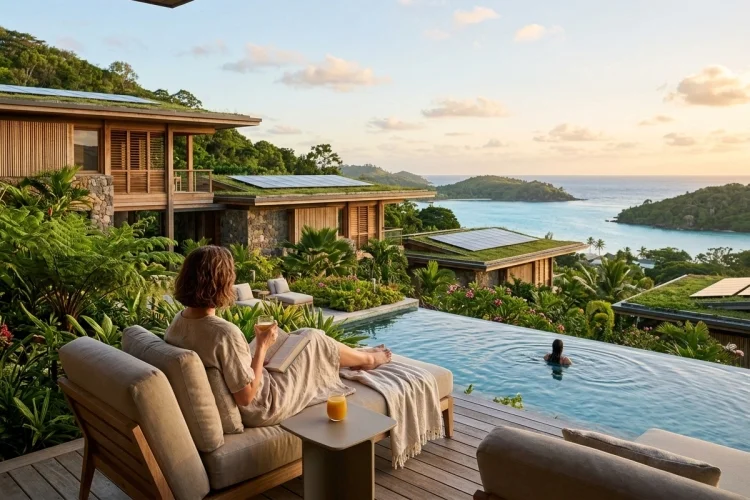
Luxury resorts are built around comfort: cool guestrooms, warm showers, beautiful pools, great food, and effortless transportation. Unfortunately, many of those experiences can also consume large amounts of energy and materials.
Designing Low-Carbon Resorts is about reducing that footprint without making guests feel that sustainability means getting less. The strongest strategies work quietly in the background.
Passive cooling, efficient building systems, low-carbon materials, renewable energy, thoughtful landscaping, and smart operations can reduce emissions while keeping the resort relaxing, attractive, and convenient.
Begin With Whole-Life Carbon, Not Just Electricity
Low-carbon design is often associated with reducing monthly electricity use, but that captures only part of a resort’s climate impact.
Buildings generate operational emissions through cooling, heating, lighting, hot water, kitchens, pumps, and other systems. They also carry embodied carbon from concrete, steel, glass, furniture, finishes, transportation, construction, and future replacement.
WATG argues that whole-life carbon analysis provides a more complete design framework because it considers embodied and operational emissions across the building’s lifespan.
This changes early design conversations.
A façade system that reduces cooling demand may look attractive operationally, but its manufacturing footprint should also be considered. Likewise, a low-carbon material that requires frequent replacement may not perform as well over several decades.
The goal is optimization across the resort lifecycle rather than chasing one impressive sustainability metric.
Reduce Energy Demand Before Adding Renewables
Solar panels get plenty of attention because guests can see them. Passive architecture is often less visible, but it can have an equally important role.
Building orientation, shading, insulation, window-to-wall ratios, natural ventilation, daylighting, and efficient glazing can reduce the energy required to keep guests comfortable.
USGBC reports that green buildings use around 26% less energy on average than conventional buildings and emit roughly 33% less carbon dioxide.
Its hospitality guidance also points to significant opportunities for energy and water efficiency in guestrooms, event spaces, and general hotel operations.
Design Shade Into the Experience
Shade does not need to feel like an engineering measure.
Deep verandas, pergolas, trees, covered walkways, recessed balconies, and landscaped courtyards can simultaneously reduce solar heat gain and improve the resort atmosphere.
Guests get cooler spaces to relax in, while mechanical systems have less heat to remove.
That is a better guest experience created through lower energy demand.
Make Efficient Cooling Feel Effortless
Air-conditioning is particularly important in warm-climate resorts, but low carbon does not mean asking guests to tolerate uncomfortable guestrooms.
The smarter approach is to reduce unnecessary cooling.
Occupancy controls can allow temperatures to adjust when rooms are empty. Efficient chillers, heat pumps, variable-speed equipment, energy recovery, and intelligent building controls can reduce demand while maintaining comfortable conditions when guests are present.
The U.S. Department of Energy’s Better Buildings program describes hotels as intensive energy and water consumers because many operate around the clock. It also reports that hospitality partners have accumulated about $290 million in energy and water savings since 2011.
These savings show that efficiency does not have to conflict with hospitality.
Guests care whether the room feels comforable. They generally do not care how intelligently the mechanical plant achieved that temperature.
Cut Embodied Carbon Through Smarter Material Choices
Concrete, steel, glass, and interior finishes can create substantial emissions before a resort welcomes its first guest.
That makes material selection an important part of low-carbon architecture.
Design teams can compare structural systems, reduce unnecessary material quantities, specify recycled content where appropriate, use responsibly sourced timber, and consider locally available materials that fit the climate and design concept.
At JW Marriott Jeju Resort & Spa, WATG incorporated locally sourced lava rock and architectural references to the island’s traditional forms while integrating the building with its volcanic landscape.
Local does not automatically mean low carbon, so each material still needs proper evaluation.
However, designing around materials that are durable, available, culturally appropriate, and suited to the site’s conditions can reduce unnecessary transportation and replacement.
It also strengthens sense of place.
Preserve Luxury Through Landscape and Nature
Low-carbon resorts should not feel stripped down or visually austere.
Landscape architecture can create some of the property’s most luxurious experiences while performing important environmental functions.
Native vegetation can provide shade, reduce irrigation demand, support biodiversity, stabilize soil, and create visual privacy between rooms.
WATG says its hospitality landscape approach incorporates low-carbon and low-water strategies, indigenous species, biodiversity research, and restoration of natural environments.
This allows sustainability to become part of the experience.
A guest walking through a shaded native garden may simply see a beautiful landscape. Behind the scenes, that same garden could require less water than ornamental planting, support local ecology, and reduce surrounding surface temperatures.
The enviromental strategy becomes almost invisible.
Measure Carbon Per Guest Experience
A resort can reduce total energy and still struggle to understand whether its carbon performance is actually improving.
Occupancy changes complicate the picture.
The Hotel Carbon Measurement Initiative provides a standardized method for calculating total hotel carbon emissions as well as the carbon footprint per occupied room per day and per area of meeting space. The methodology is used by more than 30,000 hotels globally.
This kind of measurement helps operators separate real efficiency improvements from simple changes in occupancy.
Suppose emissions fall 10% because the hotel had fewer guests. That is very different from reducing emissions per occupied room by 10%.
Low-carbon hospitality needs comparable metrics.
Without measurement, owners are mostly relying on good intentions.
Avoid Making Sustainability Feel Like a Restriction
Guests usually respond better when sustainable design improves their stay rather than asking them to constantly sacrifice.
Water-efficient showers should still have satisfying pressure. Low-energy lighting should still create warm atmosphere. Refillable amenities can use elegant dispensers instead of looking cheap.
The same principle applies to food, mobility, and housekeeping.
Electric buggies can feel quieter and more premium than combustion vehicles. Local seasonal food can improve culinary identity. Linen programs work better when guests are given genuine choice rather than being lectured.
IFC’s business case for sustainable hotels emphasizes that sustainability can support utility savings, investment resilience, consumer preferences, and long-term property value.
Low carbon works best when it becomes part of quality.
Use Guest Mobility as a Design Problem
Transport within sprawling resorts can create another source of emissions.
Instead of automatically depending on large fleets of vehicles, planners can create walkable clusters, shaded paths, cycling connections, electric mobility, and strategically located amenities.
This does not mean forcing guests to walk twenty minutes in tropical heat.
Master planning should reduce unnecessary distance first.
A restaurant located near guestrooms requires less transportation than one positioned far away simply because the site was poorly organized.
The result can be lower emissions, lower operating costs, and a more relaxing resort enviroment.
Designing Low-Carbon Resorts does not require removing the experiences guests value most. The better strategy is to make comfort, architecture, landscape, energy systems, materials, and mobility work more efficiently together.
Measure whole-life carbon, reduce demand before adding technology, and hide complexity behind an effortless stay. Developers should start carbon planning early, when design decisions can still create the greatest impact.