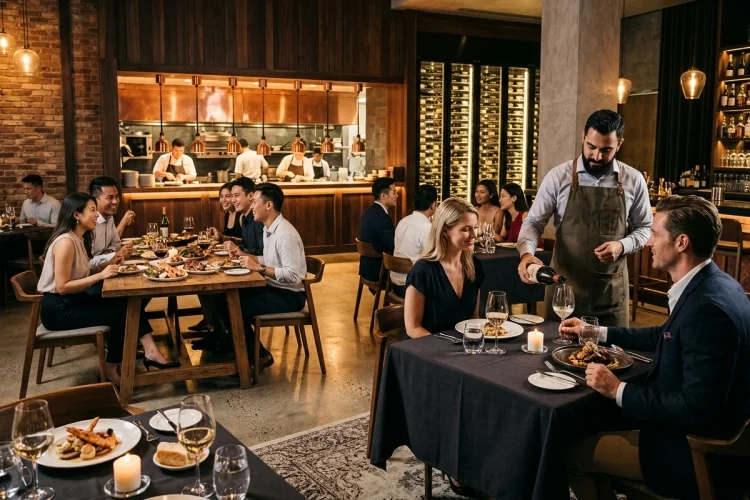
The old boundaries between fine dining, upscale casual, chef-driven restaurants, and luxury hospitality are getting harder to see.
Casual restaurants borrow premium ingredients and polished interiors, while high-end venues adopt relaxed service, louder music, and more approachable menus.
As Premium Dining Categories Converge, simply offering expensive food in a beautiful room is no longer enough to stand apart. Restaurants need clearer reasons for guests to choose them.
The strongest concepts differentiate through emotional positioning, signature dishes, recognizable service rituals, atmosphere, and experiences that competitors cannot easily reproduce.
Stop Using Price as the Main Definition of Premium
Premium dining used to come with predictable signals: white tablecloths, formal service, expensive wine, quiet rooms, and long menus.
Today, those signals are much less reliable.
A stylish upscale-casual restaurant may serve dry-aged beef, natural wine, handmade pasta, and sophisticated cocktails while maintaining relaxed uniforms and energetic music.
Restaurant Business highlighted this blurred positioning with Moxies, which describes itself as operating between casual and fine dining while emphasizing scratch cooking and a high-energy atmosphere.
At the same time, chefs with fine-dining backgrounds increasingly bring advanced technique into less formal formats. Industry predictions have similarly pointed toward more “fine fast casual” and relaxed premium concepts.
This means price alone creates weak differntiation.
Restaurants need to define what premium means specifically for their brand.
Build One Clear Emotional Position
A restaurant cannot own every occasion.
Trying to be romantic, energetic, luxurious, family-friendly, business-ready, trendy, and casual at the same time usually creates a vague identity.
Instead, premium operators should choose a dominant emotional territory.
One restaurant might represent intimate celebration. Another could own high-energy social dining. A third might become known for culinary discovery, while another delivers understated neighborhood luxury.
That positioning should influence everything from lighting and music to menu descriptions and table spacing.
This matters because consumers increasingly need a reason to dine on-premises. National Restaurant Association research found that 90% of fine-dining operators considered growing on-premises business important to their success in 2025.
When food quality can be replicated elsewhere, the emotional reason for visiting becomes more valuable.
Turn Signature Dishes Into Brand Assets
Excellent food is expected in premium dining.
Recognizable food is more powerful.
Restaurants should identify a few dishes, drinks, or preparation styles that customers immediately associate with the brand.
It could be a tableside pasta, wood-fired seafood, unusual bread service, signature dessert, distinctive martini ritual, or seasonal tasting sequence.
The goal is not putting novelty everywhere.
If twenty dishes are equally complicated, nothing feels particularly special.
A useful menu structure might include familiar anchors alongside several items with unmistakable brand DNA.
The National Restaurant Association’s 2026 culinary forecast reflects a similar balancing act in wider consumer demand: guests want comfort and familiarity while also seeking adventurous flavors, local sourcing, creativity, and value.
Distinctive restaurants translate that tension into a coherent menu rather than chasing every trend.
Make Service Style Difficult to Copy
Competitors can imitate ingredients surprisingly quickly.
Service culture is harder to duplicate.
A restaurant might become known for deeply knowledgeable but informal servers, highly personalized wine recommendations, conversational tableside storytelling, or unusually smooth celebration service.
The important part is consistency.
A signature ritual should feel purposeful rather than theatrical for the sake of social media.
For example, a seafood concept might bring the daily catch to the table before ordering. A modern steakhouse might offer guests a choice of finishing salts. A dessert-focused restaurant could finish one signature dish tableside.
These touches create memory because guests participate in the experiance.
Restaurant Dive has reported that diners interested in high-end restaurants frequently value distinctive atmosphere, strong service, unusual dishes, and memorable experiences—not food alone.
That is an important competitive advantage when menus across the premium market begin looking similar.
Use Design to Express the Concept, Not Generic Luxury
Marble, brass, dramatic lighting, velvet seating, and open kitchens have become common across premium restaurants.
Beautiful design still matters, but generic luxury does not automatically create identity.
The strongest spaces communicate a point of view.
A coastal restaurant might use restrained natural materials and sightlines toward an open fire.
A modern Japanese concept could focus on precision, quiet textures, and visible craftsmanship. A lively Latin restaurant might emphasize movement, music, bar energy, and communal seating.
Luxury hospitality trends are increasingly moving toward personal, culturally grounded, and difficult-to-replicate experiences rather than luxury defined mainly by ornamentation.
Restaurant design should follow the same logic.
Guests should be able to photograph one corner of the room and have regular customers know exactly where they are.
That is stronger branding than an expensive but anonymous interior.
Deliver Value Without Looking Discount-Driven
Premium restaurants also face a value challenge.
Consumers can still spend heavily, but many are increasingly selective about which occasions justify the expense.
Restaurant Dive reported that diners have been trading both up and down, with some choosing special-occasion premium restaurants while becoming more conservative during everyday visits.
Value therefore does not necessarily mean lowering prices.
It means making the experience feel worth the price.
A $90 dinner can feel better value than a disappointing $55 dinner if service, food, atmosphere, and emotional payoff are noticeably stronger.
Operators can also create price architecture.
An approachable pasta, smaller premium cut, tasting option, strong by-the-glass program, or flexible sharing format gives guests more control over spending without turning the restaurant into a discount concept.
This protects positioning while making premium dining more accessible.
Create Recognition Through Consistency
Differentiation becomes valuable only when guests experience it repeatedly.
A spectacular signature dish loses power if execution changes each week. A warm service concept becomes confusing if half the team acts formal and the other half behaves casually.
Premium brands therefore need clear operating standards behind their creativity.
Document the non-negotiables.
Which dishes must always look and taste the same? Which service moments define the concept? What kind of music fits? How quickly should guests be acknowledged?
Consistency does not require scripted hospitality.
It creates a reliable framework within which employees can be human.
That operational consistancy is especially valuable when restaurants expand because a distinctive concept can quickly become generic if its identity exists only in the founder’s head.
As Premium Dining Categories Converge, restaurants need more than premium ingredients and attractive interiors to remain memorable.
Strong differentiation comes from emotional positioning, signature products, recognizable service, meaningful design, and reliable execution.
Audit your concept from a guest’s perspective and identify three elements competitors would struggle to copy. Those elements-not price alone-should become the foundation of your premium positioning.