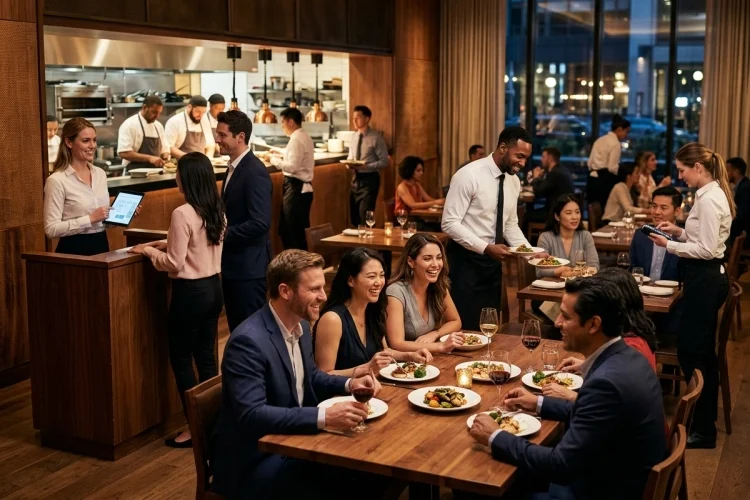
Peak dining periods can expose every weakness in a restaurant. A small delay at the host stand becomes a queue, five late tickets overwhelm servers, and slow payment suddenly leaves several parties waiting for tables.
The solution is not simply telling employees or guests to move faster. Understanding How Restaurants Reduce Service Bottlenecks means identifying the invisible pauses between each stage of service and removing unnecessary friction.
When reservation pacing, table management, communication, and payment flow work together, restaurants can handle more covers while keeping the dining experience comfortable and genuinely hospitable.
Map the Guest Journey Before Fixing the Problem
Service bottlenecks are easier to solve when operators know exactly where they occur.
A typical guest journey includes arrival, seating, greeting, ordering, food preparation, delivery, clearing, payment, departure, and table reset. A delay at any one of these stages can eventually slow the entire dining room.
For example, a kitchen may consistently produce food in 15 minutes, yet guests still experience slow service because servers need another six minutes to enter orders during the rush.
Managers can measure average time at each stage rather than relying on impressions.
Cornell restaurant revenue-management research has long emphasized understanding dining duration and the processes that influence it.
Importantly, simply shortening total meal duration does not guarantee equally large revenue gains, so operators need to focus on the right friction points rather than chasing speed for its own sake.
The objective is better service effeciency, not a stopwatch-driven dining room.
Pace Reservations Instead of Filling Every Slot
One of the biggest bottlenecks can begin before guests even arrive.
Imagine a 120-seat restaurant accepting 50 covers at 7:00 p.m. and another 45 at 7:15. The reservation book looks productive, but the kitchen may receive dozens of orders almost simultaneously.
Hosts can reduce this pressure by controlling how many covers enter each reservation interval.
OpenTable’s restaurant tools specifically include cover and party pacing features designed to control dining-room flow and help operators avoid overwhelming teams during busy shifts.
This means reservation capacity should reflect more than empty tables.
Managers also need to consider kitchen output, server sections, bartender capacity, party size, and expected meal duration.
A restaurant might discover that 25 arrivals every 15 minutes creates smooth flow, while 40 arrivals within the same period causes delays throughout service.
Spreading demand can therefore produce a busier restaurant that actually feels calmer.
Improve Table Management Between Parties
Restaurants sometimes focus heavily on how long customers occupy tables while ignoring the minutes when nobody is using them.
A party leaves at 8:10 p.m., but the table is not cleared until 8:17. It is reset at 8:22, and the next guests finally sit at 8:27.
Seventeen minutes of capacity has disappeared without any guest actually dining.
A table management system can give hosts better visibility into reservations, walk-ins, server sections, and turn times. OpenTable describes these systems as a central tool for coordinating front-of-house operations and maximizing covers while keeping shifts organized.
Restaurants can improve the same process operationally by giving employees clear reset responsibilities.
Servers should know who signals a departure. Bussers need clear priorities. Hosts should see table status immediately rather than repeatedly walking the floor.
Five minutes saved between parties can be far less noticeable to guests than five minutes removed from their actual meal.
Remove Trips That Do Not Add Hospitality
During a busy shift, servers can spend surprising amounts of time walking between tables and fixed POS terminals.
Those trips do not necessarily improve the guest experience.
Toast notes that traditional full-service workflows may require servers to make four or five trips to a POS terminal while managing one table, including entering orders, modifying items, printing checks, and processing payments.
These movements can create bottlenecks when several employees need the same service stations during peak periods.
Handheld ordering can remove some of that movement.
If an order reaches the kitchen immediately at the table, the restaurant eliminates the delay between taking the order and entering it later.
The same device can sometimes support payment when guests are ready to leave.
Technology should not replace conversation or hospitality. It should remove low-value adminstrative steps so servers have more time for the interactions guests actually appreciate.
Match Staffing to the Peak, Not the Daily Average
A restaurant may technically have enough employees for the day but still be understaffed for its busiest 90 minutes.
Demand is rarely distributed evenly.
7shifts recommends scheduling around actual demand patterns instead of applying identical staffing structures to every shift. Its scheduling guidance suggests staffing peak periods first and using POS sales history to understand where coverage is really needed.
Sales per labor hour can provide another useful signal.
If dinner generates $10,000 from 125 total labor hours, SPLH is $80. But operators should not automatically chase the highest possible number.
7shifts warns that very high SPLH can indicate that employees are stretched too thin, which may reduce service quality.
That matters because labor is already a major restaurant expense. National Restaurant Association data found salaries and wages including benefits represented a median 36.5% of full-service restaurant sales in 2024.
Smart scheduling balances cost with sufficient service capacity.
Speed Up Payment, Not the Enjoyable Part of Dinner
Guests often dislike waiting for payment more than they dislike spending extra time over dessert.
That makes the end of the meal a logical place to remove delays.
A traditional payment process can involve requesting the check, waiting for the server, receiving it, giving the server a card, waiting again, signing, and finally leaving.
Pay-at-table technology can compress several of those stages.
The important detail is timing.
Staff should never make guests feel as though the bill is being pushed toward them before they are ready. Instead, payment should become almost instant once they signal that the meal is finished.
This improves table turnover by reducing unwanted waiting rather than reducing hospitality.
Cornell research on expected dining duration similarly suggests that restaurants have some flexibility in managing meal length, but moving too aggressively can make customers feel rushed.
Good pacing should feel natural, not forced.
Track Bottlenecks With More Than One KPI
Table-turn time alone cannot explain why service is slow.
Restaurants should combine several measures, such as average seating delay, ordering time, kitchen ticket time, payment time, table reset time, covers per hour, and Revenue per Available Seat Hour.
Lightspeed describes turn time as the period guests occupy tables and RevPASH as a way to connect revenue with available seats and operating hours.
Suppose average dinner duration falls from 95 to 88 minutes.
That sounds positive, but management should check what caused the improvement.
If payment became faster and table resets improved, the result is probably healthy. If servers simply stopped offering dessert, average check and guest satisfaction may decline.
The best metric is not maximum througput.
It is higher productive capacity with stable or improving customer satisfaction, revenue, and repeat business.
Knowing How Restaurants Reduce Service Bottlenecks starts with removing waiting guests do not value.
Better reservation pacing, faster table resets, smarter staffing, mobile ordering, and frictionless payment can increase capacity without making dinner feel hurried.
Map one peak service from arrival to departure, measure where the longest avoidable pauses occur, and fix those delays before trying to shorten the meal itself.